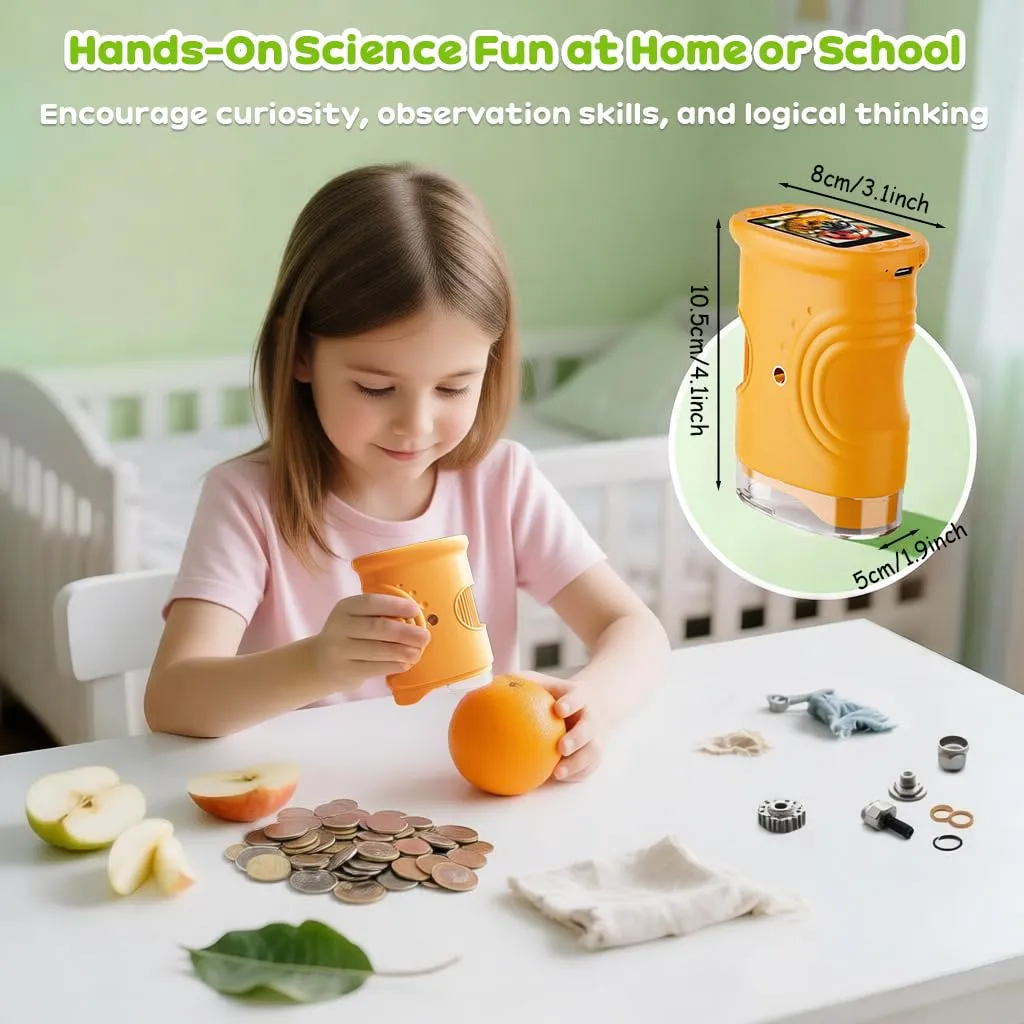

There is a moment, every parent of a curious child knows it , when a young explorer stops mid-walk, crouches down, and stares at something impossibly small on a leaf or a rock with total, unblinking focus. A beetle. A water droplet. A tiny fungus on a twig. The world is enormous to a child, but the hidden world the one invisible to the naked eye is even more so. The ZORBES 1000X Handheld Digital Microscope promises to open that hidden world for children between the ages of 3 and 12, putting a self-contained pocket microscope with a 2.0-inch IPS screen directly into small hands and inviting them to look closer at everything around them. It is a genuinely appealing idea for a children’s science gift, and for the most part with some honest caveats, it delivers on that promise.
What Is This Product?
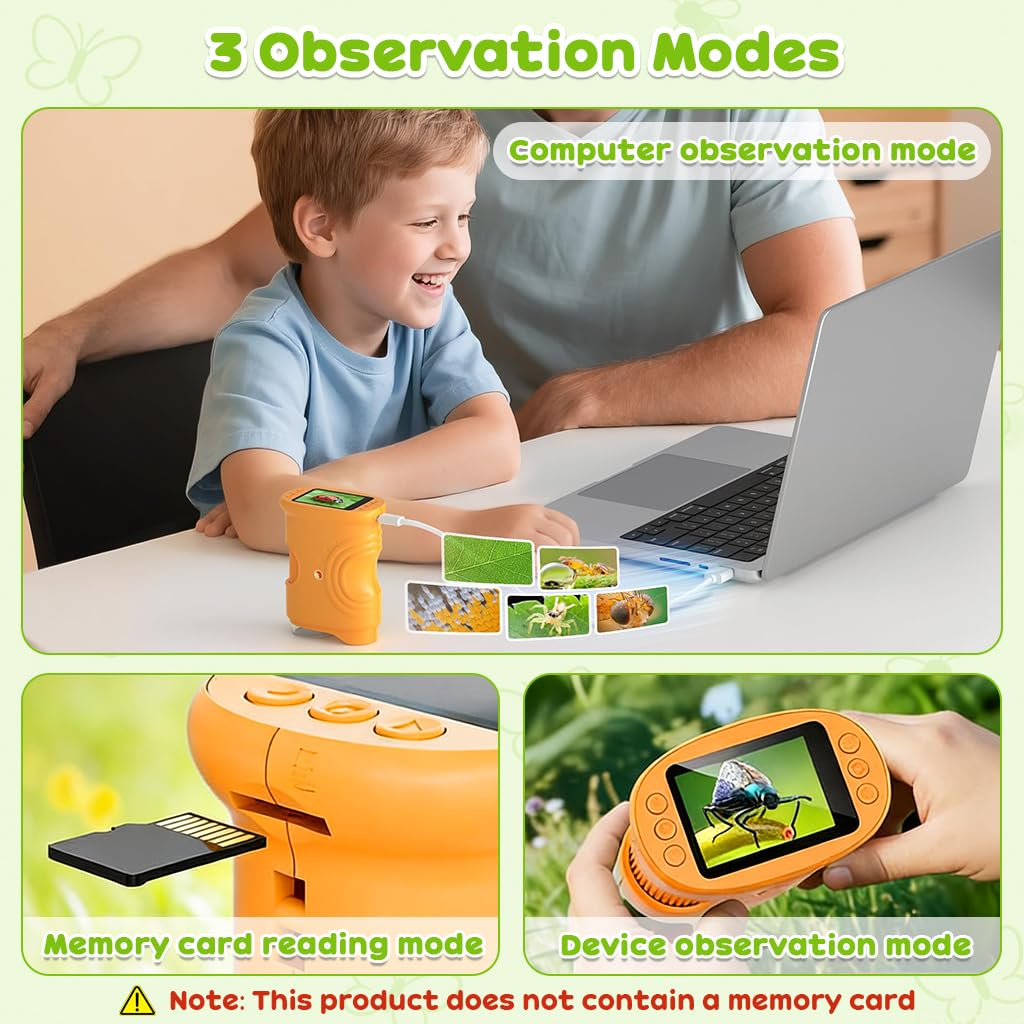
The ZORBES Digital Microscope is a compact, handheld battery-powered microscope designed for children. Unlike traditional optical microscopes that sit on a desk and require glass slides and prepared specimens, this is a fully portable digital microscope — meaning it uses a built-in digital camera sensor and lens system to capture magnified images and display them in real time on its own small screen. You hold it like a torch, point the lens at any surface or specimen, and the magnified image appears live on the display. No external phone, tablet, or computer is required.
The device features 1000X magnification (achieved through a combination of optical and digital zoom), a 2.0-inch IPS colour display, built-in LED lights for illumination, and the ability to capture photos and short video clips of whatever the child is observing. It is compact enough to carry in a pocket or small bag, and it comes in child-friendly colours clearly designed to appeal to young users.
Affiliate Disclosure: This post contains Amazon affiliate links. If you purchase through our links we earn a small commission at no extra cost to you. We only recommend products we genuinely believe in.
What the Brand Claims
ZORBES markets this as a 4K magnifying camera with 1000X magnification suitable for children as young as 3 years old all the way up to age 12. The listing highlights the IPS screen quality, the portability, the STEM educational value, and the photo and video capture capabilities. It is positioned as a birthday gift, a science kit, and a learning toy in one compact package — the kind of gift that sounds genuinely thoughtful rather than generic.
The Screen and Display — Genuinely Good for the Size
The 2.0-inch IPS display offers vibrant colours and a clear, real-time observation experience Amazon, which is the centrepiece of this device. For a screen this small on a product at this price, the IPS panel quality is a genuine positive. Children can see what the microscope is pointed at immediately and intuitively there is no delay, no setup, no pairing with a phone. The live image appears the moment the device is switched on, which is exactly the kind of instant gratification that keeps young children engaged rather than frustrated.
Colours are warm and distinct, and the display is bright enough for indoor use without straining young eyes. It is not a retina display. At 2.0 inches, fine detail requires leaning in. But as a real-time viewer for a child aged 6 and above, it works comfortably and with genuine appeal.
The Magnification — Honest Expectations Required
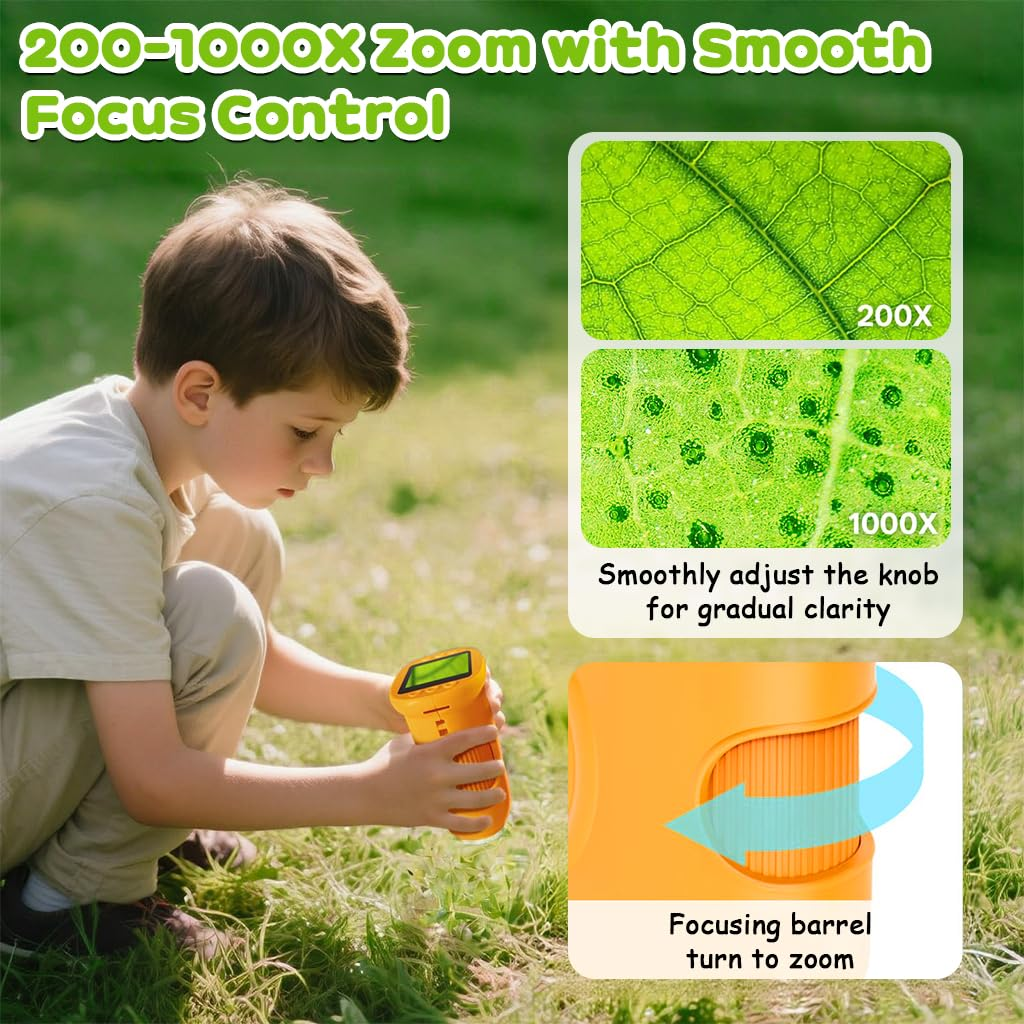
This is where careful reading of the specifications matters. The device claims 1000X magnification, but this is achieved through a combination of optical magnification (what the lens physically achieves) and digital zoom (essentially digital cropping and enlargement). The zoom function ranges from 200X to 1000X, adjustable via a side roller that even small hands can manage to get clear, magnified images. Amazon
At lower magnification levels — 200X to 400X. The image is clear, detailed, and genuinely impressive for a handheld device. A coin surface, a piece of fabric, a leaf vein, or an insect wing at these magnifications will stop a child in their tracks with genuine wonder. At the upper end of the 1000X digital zoom, the image becomes noticeably softer and grainier — this is a fundamental limitation of digital zoom, not a defect of this particular product.
For a child’s science exploration and casual discovery, the practical magnification range of 200X to 500X is excellent. Managing expectations around the full 1000X claim is simply honest.
The “4K” Claim — Worth Addressing Directly
The listing prominently features “4K” in the product name. This requires a straightforward honest note. The actual camera sensor in this category of device delivers 2 megapixel resolution Amazon — which is far from true 4K (which would require approximately 8 megapixels). The “4K” label in the product name is a marketing term, not a technical specification in the traditional sense. The captured photos and videos are adequate for sharing on a family WhatsApp group or viewing on a phone screen — they are not cinematic quality. For a child documenting their discoveries, the image quality is perfectly sufficient and genuinely fun. Just do not buy this expecting broadcast-grade footage.
The LED Illumination — A Practical Standout Feature
The built-in 8 LED adjustable lights provide excellent detail and optimal clarity, allowing children to achieve the best observation results even in low-light settings — indoors or outdoors. Amazon This is more useful than it might initially seem. Without good illumination, a microscope lens pointed at a surface in average indoor lighting produces a dark, murky image. The adjustable LEDs genuinely solve this problem, and their brightness levels give children a degree of control that feels satisfying and purposeful.
Photo and Video Capture — The Feature That Makes It Shareable
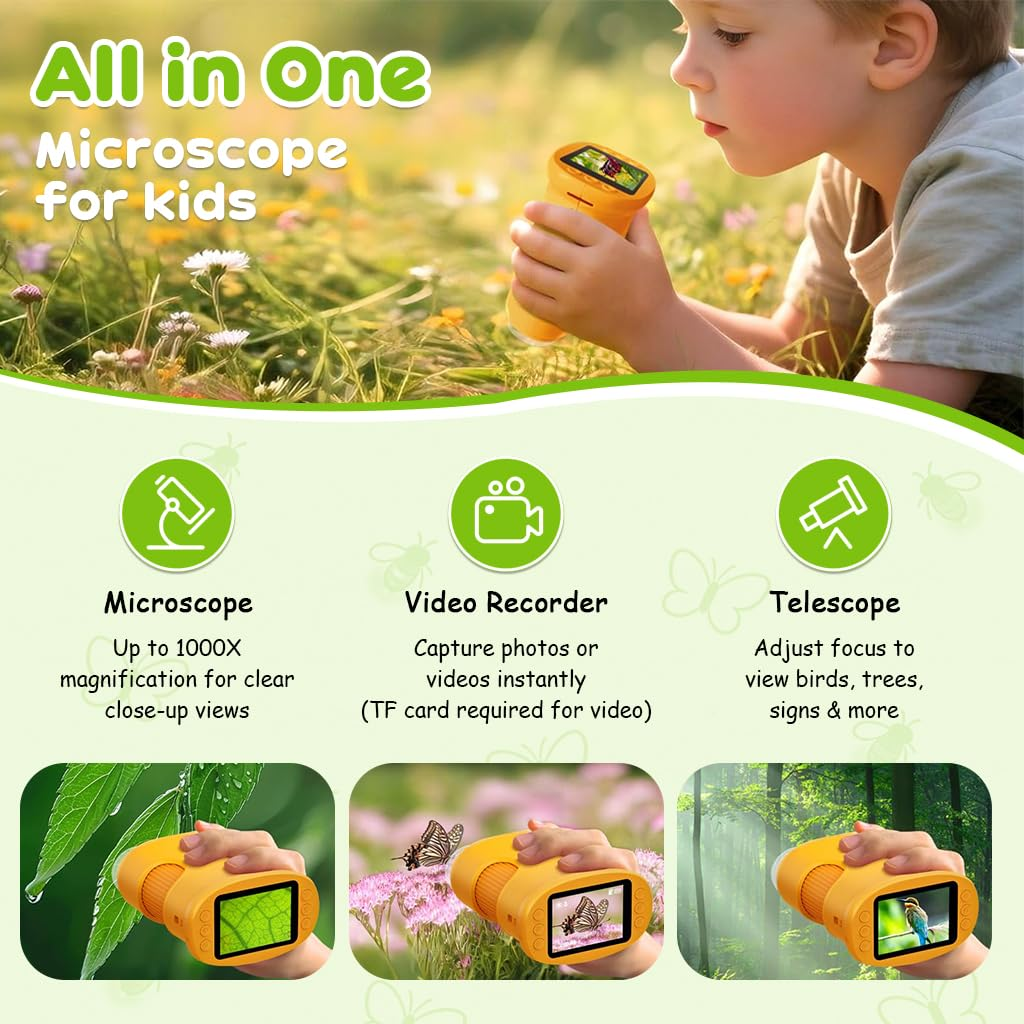
Children can capture photos and record videos of their discoveries Amazon, which transforms the microscope from a passive viewing tool into an active documentation device. A child who photographs the surface of a 2-rupee coin or captures a video of a tiny mite on a plant leaf has something to show at the dinner table, something to compare tomorrow, something to build a small personal science archive around. This feature dramatically increases the toy’s longevity — the curiosity loop of “let me find something new to photograph” can sustain weeks of engagement, not just an afternoon.
Note that video recording typically requires a TF/microSD card, which may not be included depending on the variant purchased. Worth confirming before gifting.
Portability — Genuinely Pocket-Sized
The microscope weighs only around 150 grams and is small enough to fit in a child’s pocket or bag, with a thickened neck strap to free small hands while exploring. Amazon This portability is the product’s single strongest practical advantage over traditional desk microscopes. Children who carry this on nature walks, to school science projects, on camping trips, or simply around the house will find specimens everywhere — tree bark, food surfaces, fabric textures, stationery, pet hair, and a hundred other everyday surfaces become new worlds at a moment’s notice. The combination of a built-in screen and true portability is what makes this category of microscope a genuinely different and more engaging tool than a traditional optical microscope for young children.
✅ What We Love
- ✅ Self-contained — no phone or computer required to view images
- ✅ 2.0-inch IPS display is bright, colourful, and child-friendly
- ✅ Genuinely portable — fits in a pocket, light enough for small hands
- ✅ 8 adjustable LED lights solve the low-light problem beautifully
- ✅ Photo and video capture makes discoveries shareable
- ✅ Side focus roller is manageable for children aged 6 and above
- ✅ Works on any surface — no prepared slides required to get started
- ✅ Available in child-friendly colours
- ✅ Excellent spark for curiosity, outdoor exploration, and STEM conversation
Honest Notes — What to Keep in Mind
The age range of 3–12 is too wide. The listing claims this product suits toddlers from age 3. In practice, the focus adjustment, the small screen, and the need to hold the device steady at the correct focal distance make this best suited to children aged 6 and above. A 3-year-old will enjoy pressing buttons but will struggle to get a satisfying focused image without a great deal of adult guidance. Parents buying for a child under 6 should plan to explore together rather than hand it over independently.
The “4K” label is marketing, not specification. As discussed above, the actual camera sensor is 2 megapixels. The images are good enough for a child’s science journal — not good enough for print or professional display. Set expectations accordingly.
1000X maximum is digitally achieved. The crisp, genuinely useful magnification range is 200X to roughly 500X optical. Beyond that, digital zoom applies and image quality degrades. This does not prevent genuine discovery and wonder — it simply means the upper magnification claims should be understood as theoretical rather than practically sharp.
Steady hands required for best results. An anti-shake design helps keep specimens visible even in excited little hands Amazon, but at high magnification levels, even minor movement blurs the image significantly. Older children aged 8–12 will adapt quickly. Younger children will need patience and a stable surface to rest the device against for best results.
Slides may not be included. Some variants of this device category come with prepared glass slides; some do not. Verify what is included in the specific ZORBES variant you are purchasing. Even without slides, the device works brilliantly on any flat surface — coins, leaves, food, paper, fabric — so slides are helpful but not essential.
Who Is This Perfect For?
Children aged 6 to 12 who love nature, animals, science, or who simply like looking at things very closely. Parents who want a STEM gift that goes beyond a single session of interest and actually sustains engagement over weeks. Children who already have traditional toy microscopes and find them limiting. this digital format is far more accessible and immediate. School-age children working on science projects who need a portable observation tool. Curious kids who go on nature walks and want something purposeful to do with the things they find. As a birthday gift for a child in this age range with a known interest in science or the outdoors — it is an unusually considered and genuinely useful choice.
Our Verdict
The ZORBES 1000X Handheld Digital Microscope is a legitimately fun, genuinely portable, and educationally purposeful science toy for children aged 6 and above. It does what it promises in all the ways that matter — it magnifies, it illuminates, it captures, and it delights. The caveats around the “4K” label and the practical upper limit of useful magnification are worth knowing before purchase, but they do not undermine the core experience. For a child who has ever pointed at something tiny and asked “what is that?”, this device gives them the power to find out — right now, in their own hands, wherever they happen to be. That is a genuinely good gift.
GeniePicks Rating: 3.5 / 5 ⭐⭐⭐½
👉 Check Current Price on Amazon India
🔍 Looking for more STEM toys and science kits for kids? Use ShopGenie — an AI-powered Amazon search tool built for Indian shoppers — and search with the keyword “digital microscope for kids India” to explore the full range of options available.
Has your child used this microscope or something similar? We’d love to hear what they discovered , drop it in the comments below!
GeniePicks Rating: 3.5/5 ⭐⭐⭐½
Amazon search tool built specifically for Indian shoppers. Below products can be obtained by searching in Shopgenie with the keyword as “KIDS HANDHELD DIGITAL MICROSCOPE “
No account needed. Completely free. Just smarter Amazon shopping.